

Apply these 3 principles and become a patient-centric lab
Laboratories play a key role in any healthcare system.
However, the conventional role of the laboratory can no longer effectively meet the demands of modern healthcare.
Modern healthcare is slowly adopting an individual approach to the patient.
This means that medical laboratories must adapt and face the challenges brought by this new trend.
One of these challenges is the focus on improving service quality, i.e., delivering greater value to patients.
Rob Atlas has been helping laboratories adopt new technologies and expand their roles in healthcare for many years.
“A patient-centric approach means shifting the laboratory’s business model from being based on the volume of processed samples to providing the highest quality of service.” – Rob Atlas, CEO of Atlas Medical
Furthermore, he firmly believes that healthcare is moving toward a patient-centered model, making it essential for laboratories to prepare for this change.
This implies that all laboratory processes must focus on improving the quality of service for every patient.
One way to achieve this is by using all available patient information to enhance treatment outcomes.
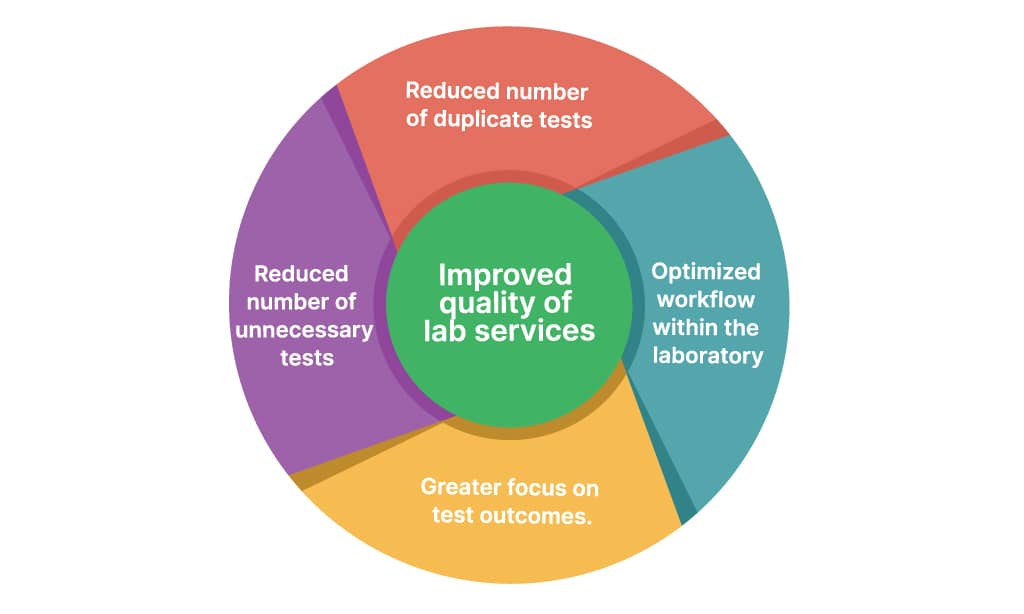
Now that we understand the goal of a patient-centric laboratory, here are three key elements that make such a laboratory better for patients:
1. Laboratory Information System (LIS)
As previously mentioned, medical laboratories play a key role in healthcare, with their significance most evident in the fact that laboratory results influence over 70% of medical diagnoses.
Every modern laboratory must meet quality standards. For clinical laboratories, the most important is ISO 15189, which defines specific quality requirements for medical laboratories.
To meet these high standards, laboratories must improve their workflows.
This is where the need for a Laboratory Information System (LIS) arises. An LIS helps meet these standards and serves as one of the foundational elements of a patient-centric laboratory.
The LIS eliminates negative anomalies in laboratory data that directly impact treatment outcomes. These include errors such as sample mix-ups or using incorrect parameters for interpretation.
For instance, independent studies show that **1 in 100 laboratory orders contains an incorrect entry for the patient’s date of birth or gender. Errors also occur at various stages of the laboratory process: **.
When transferring results from analyzers to paper. When assigning results to appropriate reference values. At every step involving “pen and paper.”
A properly implemented LIS eliminates these errors.
Every patient has a unique identifier, ensuring there is no confusion about basic data. Each new sample receives a unique barcode, which follows it through processing, and results are automatically transferred from analyzers to the system without manual transcription.
Beyond eliminating errors, the need for manual data entry is also reduced. This frees laboratory professionals to add more value, such as assisting physicians in interpreting results or educating healthcare partners about specific tests.
2. Adding Value
No one likes waiting long for test results, right?

The core idea of a patient-centric laboratory is to add value to the patient.
One way to achieve this is by reducing the turnaround time (TAT), enabling patients to receive their results faster.
Simultaneously, physicians also get test results more quickly, which is often critical for patient treatment.
The previously mentioned LIS aids this faster service delivery, as all patient data is consolidated in one place and can be shared with their physician or other healthcare partners (insurance providers, hospitals, etc.).
This interconnected system is essential for gaining a comprehensive understanding of the patient’s condition, giving physicians a better insight into their medical history.
Another way to add value is by eliminating unnecessary repetition of the same tests.
This is a significant issue in conventional laboratories due to a lack of integration among laboratories, hospitals, and physicians.
Often, a physician doesn’t have access to all the patient’s medical data and is unaware that a specific test has already been ordered or performed days or weeks prior.
On average, unnecessary test repetitions account for nearly one-fifth of all activities in conventional laboratories.
Beyond wasting time on unnecessary activities, this significantly increases costs.
However, the greatest burden falls on patients, who are subjected to the inconvenience of giving multiple samples without justification.
A patient-centric laboratory addresses these issues through an integrated system, ensuring patients receive better healthcare more simply and efficiently.
3. Better Communication
Unfortunately, laboratory professionals are often isolated from what happens to patients before and after testing.
This makes it essential for laboratory staff to develop communication skillsto ensure consultations with patients, physicians, and other healthcare partners are as effective as possible.
For laboratory professionals, a patient-centric approach means identifying, respecting, and sincerely caring for the needs, expectations, and diverse preferences of each patient.
One form of communication is explaining the sample collection and testing process to each patient. Along with this informational aspect, patients need support and understanding.
Of course, even greater value comes from quality communication with physicians.
On average, physicians spend very little time during their education learning how to order or interpret laboratory results.
Adding to this challenge is the growing number and complexity of tests, which further complicates proper interpretation.
These are the two main reasons laboratory professionals should be more actively involved in communicating with doctors and departments.
Adopting this open communication approach is a cornerstone of any patient-centric lab.
This communication and focus on patient outcomes represent a true paradigm shift. While collaboration requires mutual willingness, the change must start somewhere.
Wrap-up
The role of laboratories is inevitably changing.
A laboratory that adopts these fundamental principles will undoubtedly become more patient-friendly and contribute more significantly to healthcare as a whole.
This new laboratory is no longer focused on samples but on patients; its primary concern is not laboratory performance but patient outcomes.
This transition transforms laboratories from mere sources of results into partners in healthcare.
Of course, the heart of any laboratory is its dedicated professionals who already perform their work with great care and intentions.
However, they can and should step out of their traditional workflows.
By doing so, they can fully embrace the opportunities offered by the patient-centric approach and truly expand the role of laboratories in healthcare.
Prijavite se na naš Newsletter!
Pratite novosti i inovacije iz laboratorijskog svijeta.
Prijavi se